
Class 9 Biology Chapter 5 Notes – Cell Cycle (Punjab Boards)
Looking for complete Class 9 Biology Chapter 5 notes that explain how cells grow, divide, and reproduce? This page brings together Cell Cycle notes for Class 9 Punjab board students in one downloadable PDF — covering interphase, mitosis, meiosis, and exam-style MCQs, short and long questions — prepared according to the current Punjab Textbook Board syllabus for all Punjab boards.
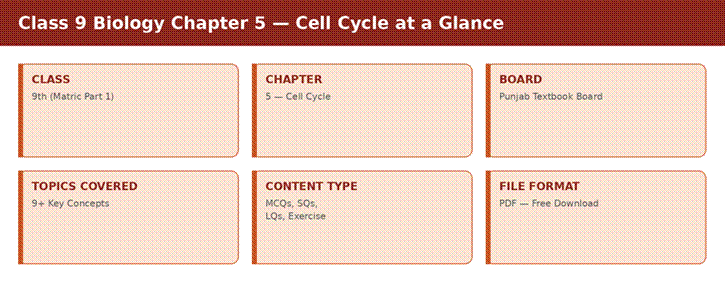
At-a-glance summary of the Class 9 Biology Chapter 5 notes
Chapter 5 Overview
Cell Cycle explains the series of events a cell goes through, from its formation to its division into new cells. It is one of the most diagram-heavy and numerically important chapters for board exams, since mitosis and meiosis questions appear almost every year. Here’s a quick snapshot:
| Detail | Information |
| Class | 9th (Matric Part 1) |
| Subject | Biology |
| Chapter | Chapter 5 – Cell Cycle |
| Board | Punjab Textbook Board (PTB) – all Punjab boards |
| Notes Include | MCQs, Short Questions, Long Questions, Solved Exercise |
| File Format | PDF (free download) |
What You’ll Learn in This Chapter
Chapter 5 covers how cells grow and divide, step by step. The notes are organized around the following core ideas, each covered once so nothing is repeated:
What Is the Cell Cycle?
The cell cycle is the complete series of events from the formation of a cell until it completes division and produces new daughter cells. It consists of two major phases: interphase and the mitotic (M) phase.
Interphase — G1, S, and G2 Phases
Interphase is the longer, metabolically active phase where the cell grows, copies its DNA, and prepares for division. This section explains the three sub-phases: G1 (growth), S (DNA synthesis), and G2 (final preparation).
Mitosis and Its Phases
Mitosis is the process by which a cell divides to produce two identical daughter cells. The notes break down its four stages — prophase, metaphase, anaphase, and telophase — along with karyokinesis and cytokinesis.
Meiosis and Its Significance
Meiosis is the reduction division that produces haploid gametes from diploid cells, occurring in two rounds (Meiosis I and Meiosis II). This section covers crossing over, chiasmata formation, and why meiosis is essential for sexual reproduction and genetic variation.
Mitosis vs. Meiosis Comparison
Since board exams frequently ask students to differentiate between the two, here’s a quick side-by-side comparison:
| Feature | Mitosis | Meiosis |
| Number of divisions | One | Two (Meiosis I & II) |
| Daughter cells produced | 2 (diploid) | 4 (haploid) |
| Chromosome pairing | Does not occur | Occurs (homologous pairs) |
| Crossing over | Absent | Present |
| Purpose | Growth and repair | Formation of gametes |
Cell Cycle Disorders — Cancer, Apoptosis & Necrosis
This added section covers what happens when the cell cycle goes wrong: uncontrolled division leading to tumors and cancer, apoptosis (programmed, controlled cell death), and necrosis (uncontrolled cell death caused by injury or infection) — a frequently tested comparison in short questions.
Regeneration
Regeneration is the ability of an organism to regrow a lost body part through repeated mitotic divisions, illustrated in the textbook with examples such as a starfish regrowing a lost arm.
Note: This page focuses on notes structure and downloads. For full diagrams of mitosis and meiosis stages and detailed explanations, download the complete PDF using the link below.
What’s Included in These Notes
- Important definitions and key terms explained in simple language
- Complete Multiple Choice Questions (MCQs) with answer keys
- Short Questions (SQs) commonly asked in board papers
- Long Questions (LQs) with exam-style, structured answers
- Fully solved textbook exercise (objective and subjective parts)
- Labeled diagrams of mitosis and meiosis phases
Applicable For All Punjab Boards
These notes follow the current Punjab Textbook Board syllabus, so they apply equally to students across every Punjab board:
| # | BISE Board |
| 1 | BISE Lahore |
| 2 | BISE Rawalpindi |
| 3 | BISE Faisalabad |
| 4 | BISE Gujranwala |
| 5 | BISE Multan |
| 6 | BISE Sargodha |
| 7 | BISE Bahawalpur |
| 8 | BISE Dera Ghazi Khan |
| 9 | BISE Sahiwal |
How to Download the PDF
- Scroll to the download button below this section.
- Tap or click the “Download PDF” button.
- Your Class 9 Biology Chapter 5 notes PDF will start downloading automatically.
- Open the file in any PDF reader — no sign-up or login required.
[ Download Class 9 Biology Chapter 5 Notes PDF ] — CTA button placeholder
Why These Notes Are the Best Choice
- Updated according to the latest Punjab Textbook Board syllabus
- Covers MCQs, SQs, LQs, and exercise in a single PDF — no need to search multiple sites
- Includes the Mitosis vs. Meiosis comparison and Cell Cycle Disorders topics often missing elsewhere
- 100% free to download, with no registration required
- Valid for students of every Punjab board, not just one city
Frequently Asked Questions (FAQs)
How can I download Class 9 Biology Chapter 5 notes PDF?
Simply click the download button on this page. The PDF will start downloading immediately, and no login or payment is required.
Are these notes valid for all Punjab boards?
Yes. Since they follow the Punjab Textbook Board’s official syllabus, these notes are valid for BISE Lahore, Rawalpindi, Faisalabad, Gujranwala, Multan, Sargodha, Bahawalpur, Dera Ghazi Khan, and Sahiwal.
What is the main difference between mitosis and meiosis?
Mitosis produces two identical diploid daughter cells for growth and repair, while meiosis produces four haploid cells for reproduction, involving chromosome pairing and crossing over that mitosis does not.
Does this chapter cover cancer and apoptosis?
Yes. The notes explain how uncontrolled cell division can lead to tumors and cancer, and distinguish apoptosis (programmed cell death) from necrosis (injury-related cell death).
Is this Class 9 Biology Chapter 5 notes PDF free to download?
Yes, the notes are completely free to download, and you do not need to create an account or share personal details.
Explore More Class 9 Biology Notes
Continue your revision with related chapters: Chapter 4 – Cells and Tissues notes, and Chapter 6 – Enzymes notes, both available in the same easy-to-download PDF format.